Relationships
Dating with a disability: disclose the logistics, not the diagnosis
 By Kenneth Kintsugi, holistic relationship specialist · Nov 14, 2026 · 11 min read
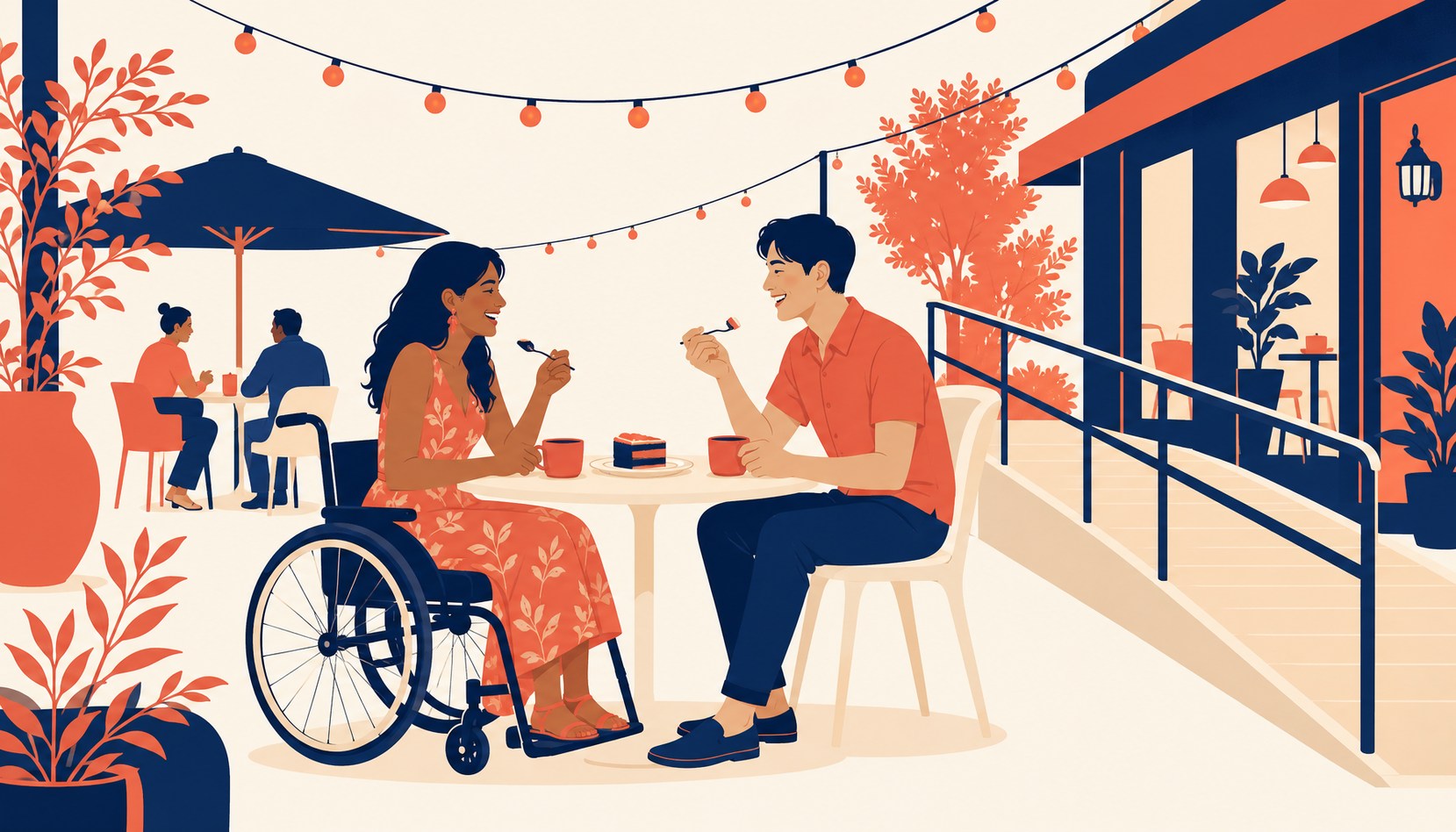
Yes, you can date with a disability, and the most useful move is to plan the date around access instead of agonizing over when to disclose. Tell your match the logistics a date needs (a step-free entrance, a quiet table, a seat near the door, a time limit) and keep the medical story for whenever you choose to tell it. Below you'll find an access-first first-date checklist, example lines for a profile, a chat and the day before, and an honest look at what the research and the apps actually say.
Our thesis: a point of view, not a study result
Most advice fixates on one question: when do I disclose? We think the weight belongs somewhere else. Disclose the logistics, not the diagnosis. Plan the first dates around access (the venue, the route, the seating, the energy budget) so the date shows the person instead of the building's barriers. Share what a date needs to know to plan with you, like “I use a wheelchair, so I'll pick somewhere step-free,” rather than a medical history. That turns disclosure from a confession into a plan two people make together, and how a match responds to that plan tells you a lot. Nobody has tested this framing in a study. It's our reading of the sources below.
How common disability is, and what the research says about dating
Disability is far more common than dating advice tends to assume. The CDC's Disability Impacts All of Us page (published May 2026, citing the CDC Disability and Health Data System, updated July 2024) says more than 1 in 4 U.S. adults have some type of disability. An earlier CDC release, dated July 16, 2024, put the figure at over 70 million adults, using 2022 data from the Behavioral Risk Factor Surveillance System.
The same CDC page lists the share of adults by type: cognition 13.9%, mobility 12.2%, independent living 7.7%, hearing 6.2%, vision 5.5% and self-care 3.6%. People can have more than one, and categories like cognition and hearing usually can't be seen across a table, so this guide covers non-apparent disabilities too.
Attitudes are the harder part. The most citable study we found is not American: Ip, Honey and McGrath surveyed 2,208 people aged 18 to 35 in Australia and Hong Kong and published the results in Sexuality and Disability in 2022. Over 80% said the presence of a disability was important or a bit important when choosing a date. Among those who said it mattered, 1,329 answered about physical disability: 34.5% were conditionally open to dating someone with one and 69.8% said they would prefer not to (answers could fall in both groups). Respondents most valued loyalty, honesty, dedication, humor and kindness, qualities that don't exclude anyone.
We can't say how those numbers would look in the U.S. today, so treat the study as one data point about young adults in two places. Still, the word conditionally matters to us. If openness often depends on conditions, it helps when the conditions are concrete, like stairs or noise or timing, instead of a label.
Why “when do I disclose?” is the wrong question
The timing debate assumes disclosure is one big announcement that you either make early and risk rejection, or make late and risk looking secretive. A diagnosis line invites your match to judge a category, often from whatever they've seen on TV. A logistics line invites a decision about a Saturday, which is something they can actually answer.
It also keeps you in charge of the story. You decide how much medical detail anyone gets, and when.
| Situation | Diagnosis-first line | Logistics-first line |
|---|---|---|
| Wheelchair user | A paragraph on why you use a chair | “I use a wheelchair, so I'll pick somewhere step-free. Do you have a favorite spot?” |
| Fatigue that varies | A list of conditions and symptoms | “I do best with a two-hour date and a seat. Dinner earlier in the evening works well for me.” |
| Hearing loss | An apology for needing repeats | “I hear best in quiet rooms and I read lips, so a corner table beats a loud bar.” |
| Limited walking or standing | An explanation of why | “I can't do a long walk. Let's meet somewhere with a seat and parking close by.” |
None of this means you owe anyone silence about your health forever. If the relationship grows, the diagnosis conversation will come, and you'll have a better sense by then of who you're telling.
The access-first first date checklist
Run this list before you agree on a place. Whoever picks the venue can do it, and if you're the one with access needs, doing it first means the date starts on terms that work.
The venue
- Entrance. Is it step-free from the street or the parking lot? Does the door open without a heavy push, or is there an automatic opener?
- Inside. Is there room between tables for a chair, walker or cane? Is the restroom on the same level and reachable?
- Check, don't guess. A venue's website can be out of date. A two-minute call (“Is there a step at the front door, and is the restroom accessible?”) settles it.
The route
- Parking or drop-off. How far is it from the car or the stop to the door, and is that stretch flat and lit?
- Transit. If either of you takes transit, does the stop have working access, and what's the plan if it doesn't?
Seating and the senses
- Where you'll sit. Ask for a table, not a high-top, if a seat with a back matters. Say so when you book.
- Noise and light. A corner table in a quieter room helps with hearing, focus and sensory comfort alike. Daytime visits are often quieter than evenings.
The energy budget
- Pick a length. Decide on a window up front (“let's do two hours”) so no one has to push past their limit or invent an excuse.
- Pick a time of day. Choose the part of your day when you usually have the most to give, and say so.
- Build in a pause. One venue with a seat beats three stops. If you want a second stop, make it optional.
The exit and the follow-up
- An easy ending. Agree that either of you can call it early with no explanation. “I'm running low, can we pick this up next week?” should land as ordinary.
- The ride home. Know how you're getting back before you arrive.
Example lines, from profile to the day before
These are templates, so change the words until they sound like you. Each one names a need and offers a plan, and none of them asks for permission.
In your profile
- “I use a wheelchair, so my first-date spots are step-free. I know a few great ones.”
- “My energy runs best in the daytime, so I'm a brunch-and-a-walk-in-the-park person.”
- “I'm hard of hearing. Quiet cafés, text before calls, and I'll tell you if I missed something.”
- “Chronic fatigue means I plan around my energy. I'm usually worth waiting for, and I'll always say so if I need a reschedule.”
Some people prefer to say nothing in the profile and put the line in the first real conversation. That's a fair choice, since it's your information.
In chat, once you're planning
- “Before we pick a place, a quick heads up: I need step-free access and a table, not a high-top. Any spots you like that fit?”
- “I do best with a short first date, about two hours. Does Saturday at 11 work?”
- “Loud rooms make it hard for me to follow a conversation. Could we try somewhere quieter?”
The day before
- “Looking forward to tomorrow. I called ahead, and the front entrance is step-free and the restroom is accessible. I'll grab us the corner table.”
- “If I'm having a low-energy day I'll tell you before, not during. Is it okay if we reschedule if that happens?”
What a match's response tells you
This is our reading, not a measured result, but it's what we'd watch for after you share a logistics line.
- A good sign. They answer the plan. They suggest a place, ask what would make it easier, or just adjust and move on. Curiosity about you shows up too, and it isn't a quiz about your body.
- A mixed sign. They're warm but vague, or they ask a lot of medical questions you didn't offer. You can redirect with “I'll share more once we know each other better,” and see how they take it.
- A clear sign. You told them you need step-free access and they choose a walk-up bar anyway, or the replies vanish right after the logistics message. That's information, and you got it before you invested an evening or a lot of feeling.
What the disability-focused and mainstream apps say about themselves
We looked at what the apps and their coverage state, and we describe only that. Checked November 14, 2026.
- Dateability. The company's September 16, 2025 press release calls it “the only dating app designed for the disabled and chronically ill communities” and says version 2.0 added enhanced screen-reader support and a redesigned interface. It was listed on Apple's App Store when we checked. Those are the company's claims, and we haven't tested the app.
- Hinge. Hinge's accessibility statement (published and last reviewed August 26, 2025) says Hinge is endeavoring to conform with WCAG 2.2 Level AA and EN 301 549, to be functional with popular screen readers, and to offer adjustable contrast and text scaling. It also says “there is more work to be done.” Those are Hinge's own claims, and we haven't audited them.
- Everything else. We didn't verify Bumble, Tinder or any other app, so we're not describing them. Read an app's own accessibility page before you rely on it.
A word on benefits, if you receive them
This one isn't romantic, but it's real. If you receive Supplemental Security Income (SSI), a relationship that becomes a marriage can change your benefits. SSA's payment table lists the 2027 federal maximum as $1,029 a month for an eligible individual and $1,544 for an eligible couple, about 25% less than two individuals would get ($2,058). SSA's income guide also says that when a recipient lives with a spouse who isn't eligible, it “may count some of the spouse's income.” Check with SSA or a benefits counselor before making decisions about moving in or marrying.
If you're dating someone with a disability
You don't need to become an expert. A few habits cover most of it.
- Follow their lead. If they've told you what works, use it. If they haven't, ask about the date, not the diagnosis: “What would make Saturday easy for you?”
- Offer choices instead of deciding. “I found two places, both with step-free entrances. Which feels better?” respects their expertise about their own needs.
- Don't touch equipment or take over. Ask before you help with anything, and take a “no thanks” at face value.
Where a matchmaker fits
A matchmaker can carry the logistics conversation for you, which is helpful if you're tired of making the same announcement to every new match. In practice that could mean passing along “step-free, quiet, a short first date” before two people meet, and introducing you to people who are open to that. NexSpark's introductions are ID-verified, so you know who you're meeting. Our page on how matching works explains the process, and our first date questions help once the logistics are settled.
Honest limits
The thesis is ours, and we haven't tested it. The attitudes study covers young adults in Australia and Hong Kong in a survey published in 2022, and we read its findings and Table 2. The CDC figures come from the pages we cite, and we didn't pull the underlying data. The app notes reflect what Dateability and Hinge say, as of the check date. The SSA figures are federal maximums and say nothing about your own case. We left out safety advice and any claim about specific conditions, because we couldn't source them well and we don't give medical advice.
Frequently asked questions
Should you tell someone about your disability before a first date?
There's no required moment, and it's your call. Our view is to share the logistics a date needs to plan with you, such as step-free access, a quiet table or a time limit, before the first date, and to keep the diagnosis and medical history for when you choose to share them. That makes the first date workable without turning the first message into a confession.
How do you bring up a disability on a dating profile or in chat?
Name the need and offer a plan in one sentence, for example that you use a wheelchair so you'll pick somewhere step-free, or that you do best with a two-hour daytime date. You can put a line like that in your profile or save it for when you start planning. Either way, you're giving your match what they need to plan with you, not a medical history.
What are the best dating apps for people with disabilities?
We can't rank them, because we only describe what the apps say about themselves. Dateability's September 2025 press release describes it as a dating app designed for disabled and chronically ill people. Hinge's accessibility statement, reviewed August 26, 2025, lists screen reader support and adjustable contrast and text scaling. Read each app's current accessibility page before you choose.
How do you plan an accessible first date?
Check the entrance, the route, the seating, the noise level and the energy budget before you agree on a place, and call the venue instead of trusting its website. Pick a start time and a length, and agree that either of you can end the date early with no explanation.
How do you date someone with a disability?
Follow their lead and ask about logistics instead of the diagnosis. Offer choices, such as two step-free restaurants, rather than deciding for them, ask before helping, and treat a rescheduled date as an ordinary change of plan. Let them share their medical story when they're ready.
Does marriage affect disability benefits in the U.S.?
It can. SSA's 2027 table sets the SSI couple rate at $1,544 a month against $1,029 for an individual, and SSA says it may count some of an ineligible spouse's income. Check with SSA or a benefits counselor before you decide anything about marriage or living together.
Sources
- Centers for Disease Control and Prevention, Disability Impacts All of Us, page published May 5, 2026, citing the CDC Disability and Health Data System (updated July 2024). Accessed November 14, 2026.
- Centers for Disease Control and Prevention, CDC Data Shows Over 70 Million U.S. Adults Reported Having a Disability, July 16, 2024 (2022 BRFSS data). Accessed November 14, 2026.
- Ip, I. M. H., Honey, A., and McGrath, M., Attitudes Toward Dating People with Disability Amongst Young People in Australia and Hong Kong, Sexuality and Disability, 40, 233 to 244, published online April 16, 2022 (n = 2,208, ages 18 to 35). Accessed November 14, 2026.
- Hinge, Accessibility Statement, published and last reviewed August 26, 2025. Accessed November 14, 2026.
- Dateability, Inc. via Business Wire, Dateability Revolutionizes Accessible Online Dating, September 16, 2025. Accessed November 14, 2026.
- Social Security Administration, SSI Federal Payment Amounts for 2027, and Understanding Supplemental Security Income: SSI Income (2026 edition). Accessed November 14, 2026.
Want the logistics conversation handled before you meet?
Answer a few honest questions, meet your archetype, and let a real matchmaker (assisted by AI) introduce you to someone who fits. Every introduction is ID-verified.