Relationships
Love languages, explained: how to actually use them while dating
 By Kenneth Kintsugi, holistic relationship specialist · Jul 2, 2026 · Updated Sep 20, 2026 · 8 min read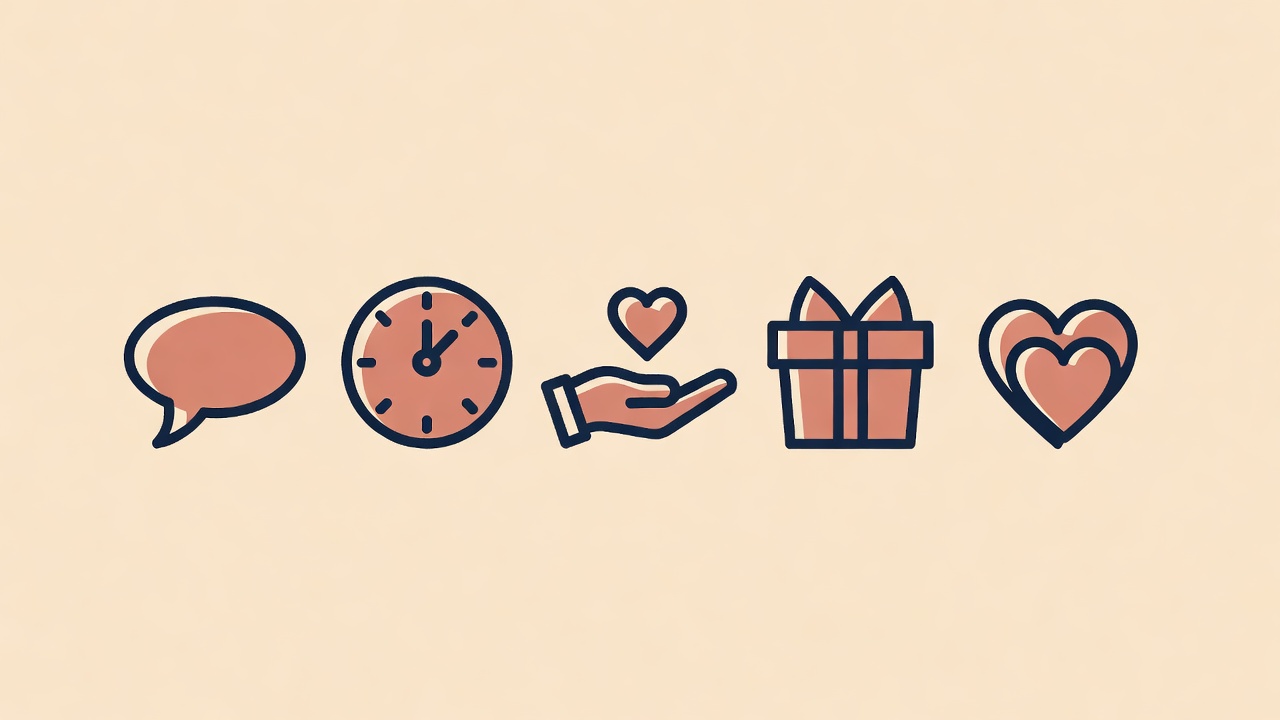
The five love languages might be the most famous idea in modern relationships, and the most misused. People wield them like a personality horoscope ("sorry, I'm just not a words person"), treat mismatches like dealbreakers, and skip the part that actually matters: they were never meant to describe who you are. They describe what makes you feel loved. Those are different things, and the difference is where dating gets interesting.
The five, in thirty seconds
Gary Chapman's framework says people give and receive care in five main currencies: words of affirmation (being told, specifically and sincerely), quality time (undivided attention, the phone face-down kind), acts of service (someone noticing what would help and doing it), gifts (tokens that prove "I thought about you when you weren't there"), and physical touch (proximity, affection, a hand on the shoulder at the right moment). Most people feel all five and prioritize one or two.
What the science actually says
Worth being honest here, because the framework gets treated as settled fact: it isn't. A 2024 review in Current Directions in Psychological Science found people don't reliably sort into one fixed language at all: ratings of all five languages correlate with each other at r = .54 to .75, and attempts to confirm five separate factors have instead turned up three, or four, depending on the sample. The same review reports that a 2023 analysis of matching, whether partners share a primary language, found almost no relationship between matching and satisfaction. Expressing any of the five was tied to feeling more loved, whether or not it happened to be the receiver's stated favorite.
The more useful study actually measured couples. A 2022 study of 100 couples found matching didn't predict much of anything, but a mismatch, what a partner said they wanted versus what they actually got, did: it tracked with meaningfully lower satisfaction, both for the person going without and for the partner who wasn't delivering it. So the payoff isn't finding someone who happens to share your language. It's finding out, directly, what your specific partner asked for, and doing that thing, even when it isn't the way you'd naturally express care yourself.
Which is the underlying insight the critique doesn't touch: people genuinely differ in how care lands for them, and the way you naturally express care is not automatically the way your person receives it. Treat love languages as a vocabulary for that conversation, not a diagnosis, and not a compatibility test.
Skip the guessing, compare directly
Six quick questions on how you actually notice and give love, then send your partner a link to their own version so you can see exactly where you line up and where you don't, and what that pairing means. Free, no email, about two minutes each.
How to spot someone's language on a date (without asking the quiz question)
"What's your love language?" is a fine question for date three. But people show you earlier than they tell you, because most people give in the currency they want to receive. Watch for it: the date who remembers what you said last week and brings it up (words), the one who plans the evening around something you mentioned loving (acts of service), the one who'd rather have one long uninterrupted conversation than hit three bars (quality time), the one who shows up with something small, a book, a pastry, "because it made me think of you" (gifts), the one who navigates by light touch (touch). How they complain is data too: "we never just talk anymore" and "they never plan anything" are two different homesicknesses.
The trap: using your language as an excuse
The framework's dark pattern is self-justification. "I'm acts of service, so I don't say nice things" is not a love language, it's a limitation wearing a label. The entire point is the opposite: knowing your default lets you stretch past it on purpose. In dating terms: express care in your natural currency, but learn to convert. The person who can say the kind thing and fix the shelf and put the phone away is not a unicorn; they're just someone who treats care as a skill instead of a setting.
Finding your own language without taking a quiz
You don't need Chapman's official test to figure out your own default, the pattern shows up in what you already complain about. Notice what you bring up most when you feel unappreciated: is it "you never say anything nice," "you never help with anything," "we never spend real time together," "you never think to bring me anything," or "you never touch me anymore"? Each complaint maps directly to one of the five. The version you reach for fastest, the one that feels most unfair when it happens, is usually pointing straight at what you actually need. It's often easier to spot in frustration than in a quiz question, because frustration is the currency that's running low.
Mismatches aren't dealbreakers, unread signals are
A words person dating an acts person isn't doomed. What dooms couples is the translation failure: one partner faithfully doing the dishes as a love letter while the other waits, starving, for a sentence. Both are giving. Neither is receiving. One honest conversation fixes it, "here's what lands for me", which is why mismatched languages with good communication beat matched languages without it, every time. This rhymes with what we've written about attachment styles: the pattern matters less than whether both people can name it.
Using this before there's even a relationship
On early dates, the practical move isn't decoding them, it's making sure the full range of your own care is visible. Say the specific compliment out loud. Plan one thoughtful detail. Give real attention. You're not performing all five languages; you're making sure a receiver of any type can hear you. And notice what you feel starved of by date four, that's your own language announcing itself. (Good prompts help: our 40 first-date questions includes several that surface this naturally.)
Love languages outside romance
The framework didn't start as a dating tool, Chapman originally wrote it for married couples, but the underlying idea, that people give and receive care differently, holds up just as well with friends, family, and even coworkers. A friend who always remembers your coffee order is speaking gifts. A friend who shows up to help you move without being asked is speaking acts of service. Recognizing this outside of romance is good practice, since it's lower-stakes than trying to read a date, and the same skill of noticing how someone naturally gives care transfers directly once you're back in dating mode.
Where this fits in compatibility
Love languages are a communication layer, not a foundation. They tell you how to deliver care, not whether your lives point the same direction, that's values, timelines, and what you're each actually looking for. It's why NexSpark's questions measure how you bond and what you need to feel secure alongside lifestyle and values, and why our match reports tell each pair not just that they fit, but how to make the other person feel it. The vocabulary is Chapman's; the matching underneath has to be deeper.
Learn how you bond, and who fits it
A few honest NexSpark questions read your relationship style, values, and the way you give and receive care, then reveals your ideal match. Identity-verified members, human matchmakers on every introduction.